

Business Operations Assessment, Financial Performance & Growth Strategy
Executive Summary
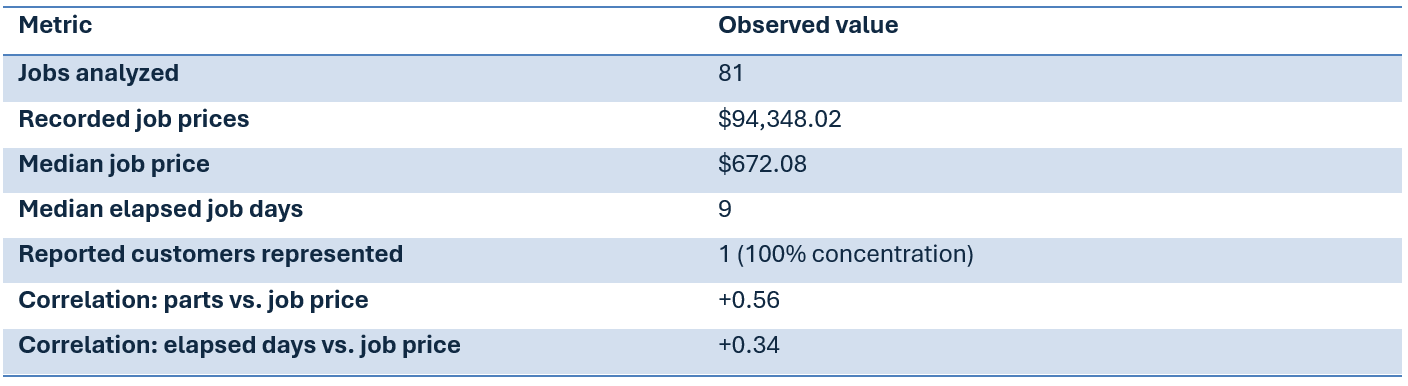
The supplied records contains 81 priced job records across its 2025 and 2026 sheets, totaling $94,348.02 in recorded job prices. The records cover December 2024 through September 2026. The owner described all recorded jobs as originating from one customer. That concentration—not a demonstrated shortage of machining expertise—is the clearest strategic constraint on growth. Kelly Solutions is operated by a highly capable master machinist with one HAAS Mini Mill; diversifying demand would help reduce dependence on a single buyer and create more opportunities to deploy that capability.
The temporary engagement combined operational discovery, business model evaluation, market segmentation, lead generation, website and brand development, along with administrative process documentation.
Headline Indicators
Engagement Scope and Business Context
Business setting: a small owner-operated machining business, with one master machinist and a HAAS Mini Mill. Capabilities discussed included prototype and precision milling work in aluminum, titanium copper and plastics, serving applications such as aerospace, automation, semiconductor equipment and custom components.
Data Preparation and Analytical Boundaries
The provided data contains revenue and costs for 2025 and 2026. Job fields are price per job, job-created date, days spent, completion date and number of parts. Analysis aggregates prices by completion month. The “days spent” values correspond to elapsed calendar days between job creation and completion, not necessarily hands-on machining time.
The cost information specifies “tooling and material cost per job” as 24%, approximately $150 monthly power, $810 monthly mill payments and $111 insurance. Labor, owner compensation, actual materials by job, consumables, maintenance, taxes, depreciation, rework, collections and other expenses are missing. Therefore true job profitability and net profit cannot be calculated.
Revenue and Preliminary Contribution Analysis
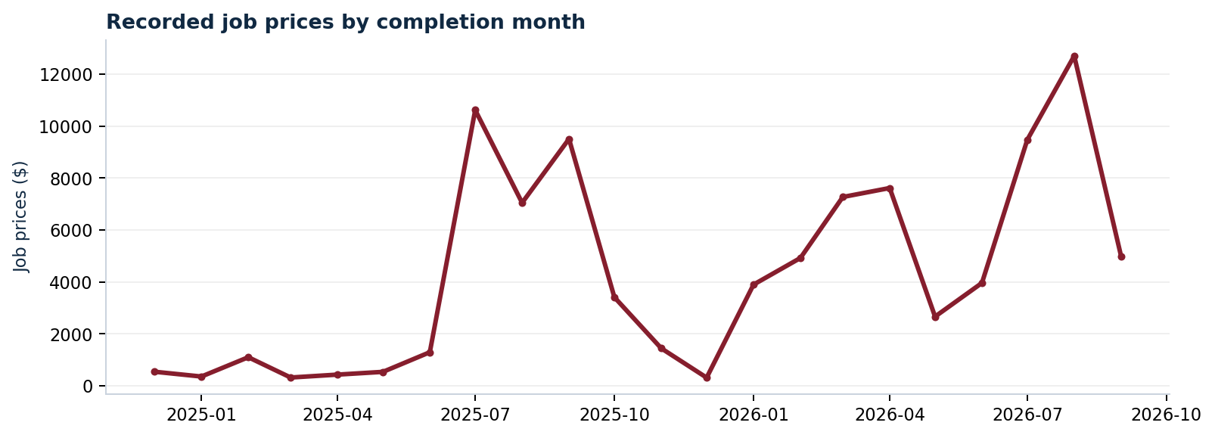
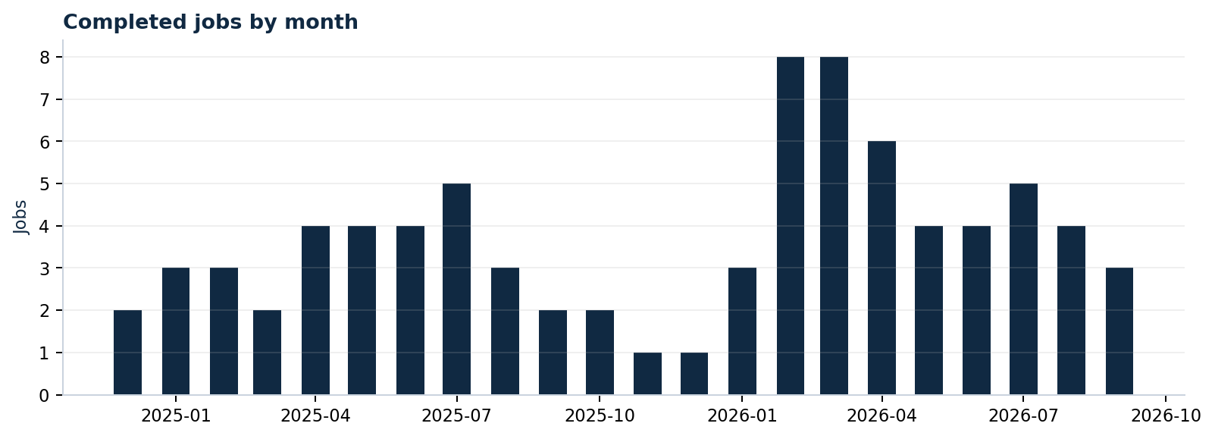
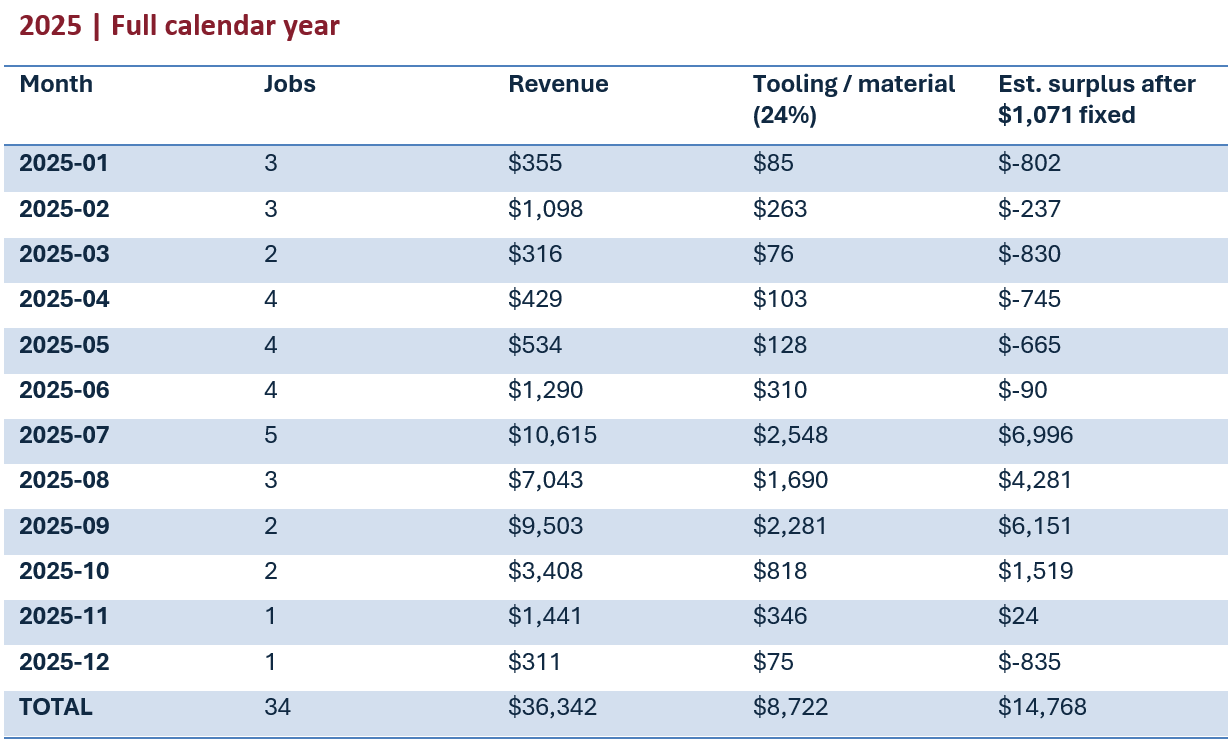
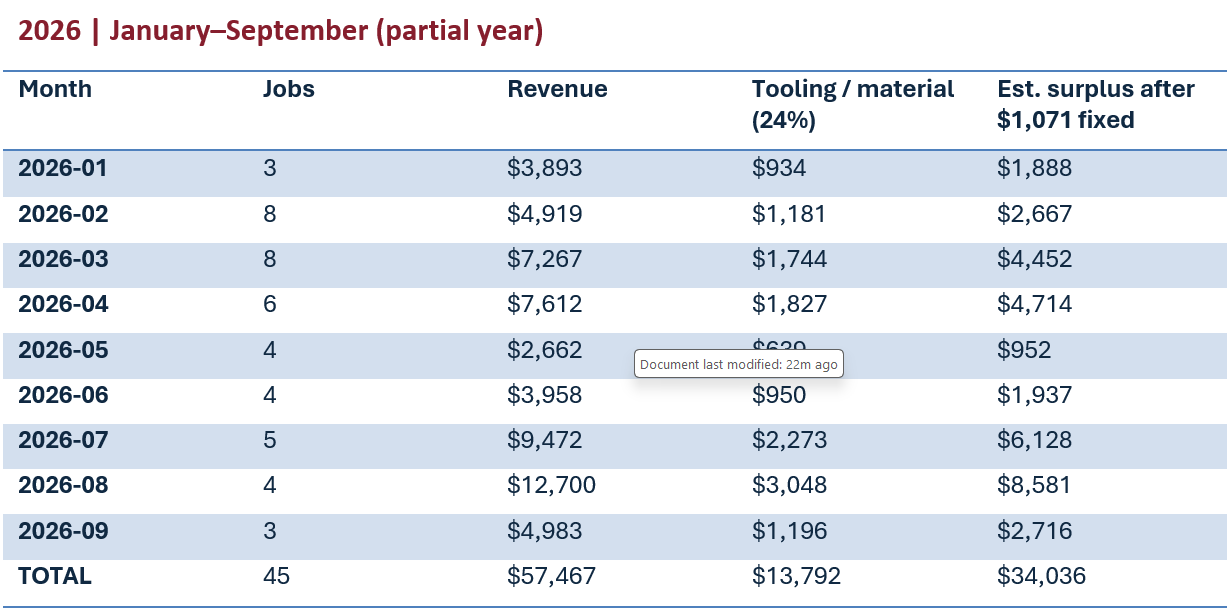
Monthly Expense Reconciliation: 2025 vs 2026
Method: revenue is the sum of recorded job prices by completion month. Estimated monthly cash surplus = job revenue − 24% estimated tooling/material costs − $150 electricity − $810 mill payment − $111 insurance. The $111 insurance charge is monthly, equivalent to $1,332 for a full 12-month year. The recurring charges total $1,071 per month ($12,852 for 2025; $9,639 for January–September 2026). Months with no recorded completed jobs still incur these expenses.
This estimate is NOT net profit: it excludes owner compensation, labor, taxes, depreciation, maintenance, repairs, consumables and any other unlisted costs. The 24% materials/tooling rate is a workbook assumption, not a verified cost for each job.
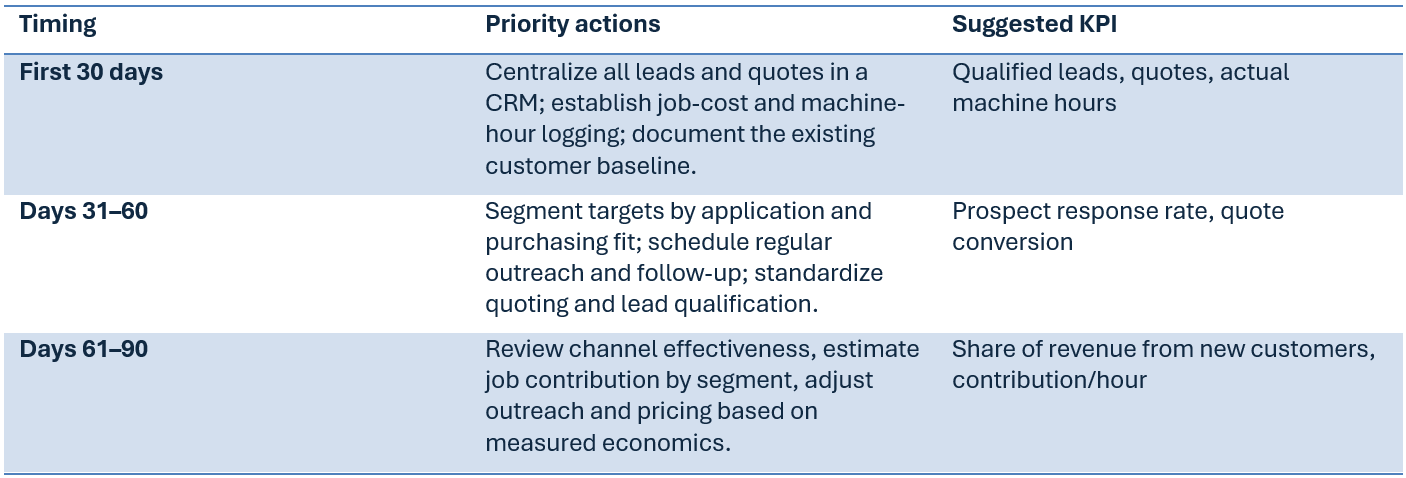
Recommendations and Implementation Roadmap
Portfolio Reflection and Limitations
This completed temporary engagement demonstrates end-to-end operational problem framing, structured business-model assessment, spreadsheet-based financial analysis, customer segmentation, B2B prospecting, process documentation and digital implementation. The strongest strategic insight is that sales diversification and measurement infrastructure must develop alongside technical production capability.
Limitations: one-customer historical sample; incomplete cost data; calendar-day rather than labor-hour durations; no measured lead-conversion or post-engagement financial outcomes; possible variation in job complexity and material mix. Conclusions should be revisited when a full job-cost ledger and sales pipeline are available.
Supplemental Completed Deliverables
During and after the discovery phase for the Executive Summary, supplemental work was completed to address identified business needs, resolve operational gaps, and establish foundational resources. These initiatives extended beyond the initial assessment and focused on improving business operations, increasing market visibility, and supporting future growth.

Logo and Branding Refinement: Refined the company logo and established consistent visual branding to strengthen professional identity, improve brand recognition, and support future marketing initiatives.

Website Content Creation: Developed all website copy, custom graphics, and supporting imagery to communicate machining capabilities, highlight industry applications, and encourage prospective customer engagement.

Website Development: Designed and launched a three-page company website using Google Sites, the client's preferred platform, establishing a professional online presence and improving customer accessibility. To see a website page showcase click here.

Business Model Canvas: Completed a comprehensive Business Model Canvas to establish a clear understanding of current operations, identify business opportunities, and guide future strategic direction. To see the Business Model Canvas click here.

Business Materials and Operational Documentation: Designed professional business cards and developed foundational operational documents, including an employee handbook, job offer letter, and onboarding and offboarding checklists.